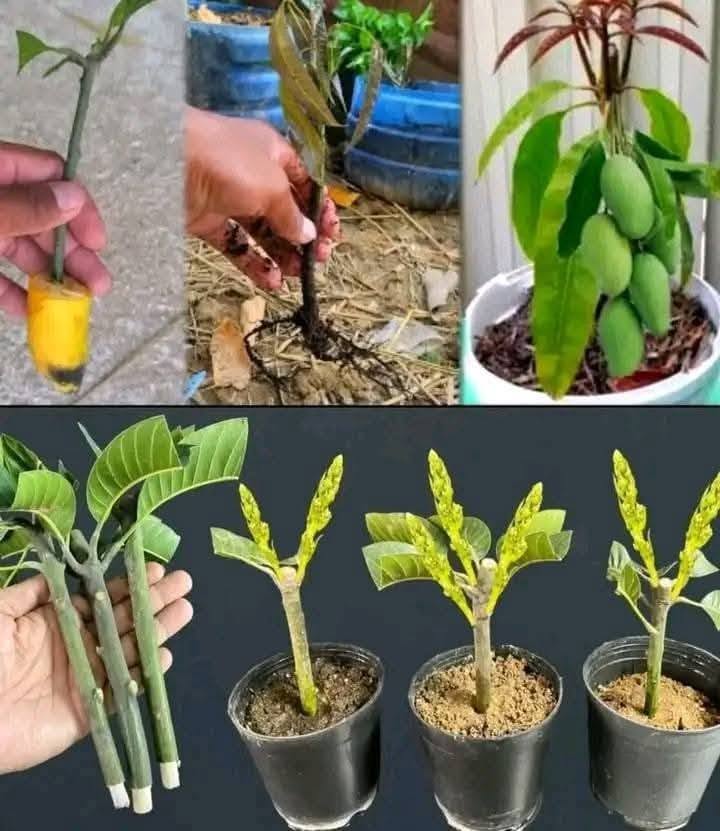
Rooting hormone is not absolutely required, but it may improve root development and reduce the time needed for roots to appear.
The Best Time to Take Mango Cuttings
The ideal time is during warm weather when the tree is actively growing. Late spring through summer is usually suitable in warm climates.
Temperatures should remain consistently warm, ideally between 24 and 30°C. Avoid taking cuttings during cold periods, extreme heat, or when the parent tree is stressed by drought, pests, or disease.
Step 1: Select a Healthy Mango Branch
Choose a healthy, disease-free mango tree with strong growth.
Look for a semi-hardwood branch. This means the stem should be mature enough to hold its shape but not completely old, thick, or woody.
The ideal cutting should:
Be approximately 15 to 20 centimeters long
Have at least two or three nodes
Come from a non-flowering branch
Show no signs of pests or disease
Have healthy green leaves
Be free from fruit or flower buds
Avoid extremely soft new shoots because they may rot quickly. Very old woody branches may also be slow to produce roots.
Step 2: Make a Clean Cut
Use clean, sterilized pruning shears to remove the selected branch.
Make the lower cut just below a node because nodes contain plant tissue that may support new root development. Cut at a slight angle to increase the exposed surface area.
Place the cutting in a damp cloth or container immediately so that it does not dry out while you prepare the pot.
Step 3: Prepare the Cutting
Remove all leaves from the lower half of the stem.
Keep one or two leaves near the top. Large leaves can be cut in half to reduce moisture loss while still allowing the cutting to perform limited photosynthesis.
Remove any flowers, buds, or young fruit. The cutting needs to direct its energy toward root development rather than flowering or fruit production.
Using a clean knife, gently scrape a thin section of bark from the bottom 2 to 3 centimeters of the stem. Do not cut deeply into the branch. Lightly exposing the inner tissue may encourage rooting.
Step 4: Apply Rooting Hormone
Moisten the lower end of the cutting slightly, then dip it into rooting hormone.
Cover the bottom portion of the stem, especially the scraped area. Tap the cutting gently to remove excess powder.
Using too much rooting hormone will not necessarily improve the result. A light, even coating is sufficient.
Step 5: Prepare the Potting Mix
Mango cuttings require a loose growing medium that holds some moisture without becoming waterlogged.
A suitable propagation mix may include:
One part coarse sand
One part perlite
One part coco coir or peat-free potting medium
You may also use a commercial seed-starting or propagation mix with added perlite.
Fill a clean pot with the mixture and water it lightly. The medium should feel evenly moist but not soaked.
Heavy garden soil is not recommended because it can compact around the cutting and increase the risk of rot.
Step 6: Plant the Mango Cutting
Make a planting hole with a pencil or small stick. This prevents the rooting hormone from rubbing off when the cutting is inserted.
Place the bottom third of the cutting into the potting mix. At least one node should be below the surface.
Press the growing medium gently around the stem so that the cutting remains upright. Avoid compacting the mixture too firmly.
Water lightly after planting to settle the medium around the cutting.
Step 7: Create a Humid Environment
A newly planted cutting loses moisture through its leaves before it has roots to replace that moisture. High humidity is therefore essential.
Cover the pot with a clear plastic bag or place it inside a propagation dome.
Use small sticks to prevent the plastic from touching the leaves. Make a few tiny ventilation holes to allow limited airflow and reduce fungal growth.
The cover should create a warm, humid environment without trapping excessive heat.
Step 8: Choose the Right Location
Place the pot in a warm, bright location with indirect sunlight.
Do not place it in strong direct sun while it is covered with plastic. The enclosed environment can heat up quickly and damage the cutting.
A suitable location may be:
Near a bright window
Inside a warm greenhouse
On a protected patio
Under filtered shade outdoors
Consistent warmth is one of the most important factors for successful rooting.